Checked November 12, 2026 against docs.perplexity.ai pricing and model pages (US prices). This is a documentation-based explainer, not a hands-on test.
Quick verdict
Cheapest grounded answers: Perplexity's own Sonar model costs $0.25 per million input tokens and $2.50 per million output tokens in the Agent API.
Raw search results only: the Search API costs $5 per 1,000 requests, or $1 per 1,000 with Fast Search.
Watch out for: in the Agent API, tool calls such as web searches and page fetches are billed on top of model tokens.
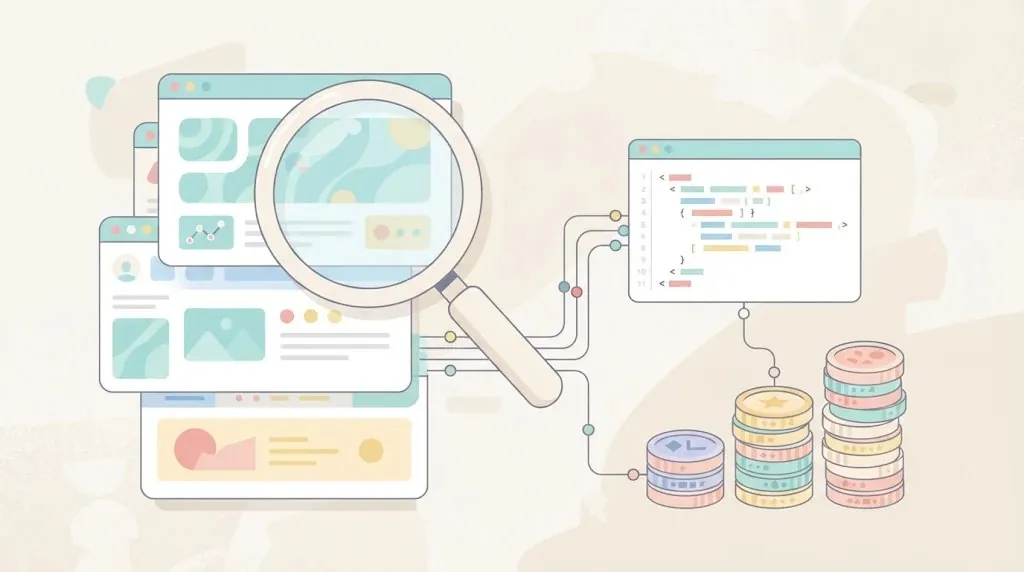
Illustration: AI Tool Audit, created with Google Gemini
On this page
Perplexity's API products in 2026
Perplexity's developer platform has grown beyond the single Sonar endpoint many people remember. Its pricing docs now cover several products, each billed differently:
- Agent API. Pick a model (Perplexity's Sonar or a third-party model), give it tools like web search, and pay per token plus per tool call.
- Search API. Get ranked web results back without a written answer. Billed per request.
- Embeddings API. Turn text into vectors for search and retrieval. Billed per token.
- Decisions API. Small classifier-style models billed on input tokens only.
- Orchestrator API. Token-billed access to Perplexity-hosted models. It is in private preview and access is requested by email.
The pages we checked did not list separate rates for older names such as Sonar Pro, Sonar Reasoning or Sonar Deep Research, or the per-request fees by search context size that used to apply. If you are on an older integration, check your own billing dashboard before you assume today's rates apply.
Sonar and other Agent API models
The Agent API lists every model at a per-million-token rate. Sonar is described as Perplexity's grounded search model. A sample of the list:
| Model (as listed) | Input per 1M | Output per 1M | Cache read per 1M |
|---|---|---|---|
| perplexity/sonar | $0.25 | $2.50 | $0.0625 |
| perplexity/glm-5.3-flash | $0.15 | $0.50 | $0.03 |
| perplexity/kimi-k3 | $3.00 | $15.00 | $0.30 |
| openai/gpt-6-luna (up to 272K) | $0.10 | $0.50 | 90% off input |
| anthropic/claude-sonnet-5-5 | $2.00 | $10.00 | $0.10 |
| google/gemini-3.7-flash | $0.75 | $3.75 | $0.075 |
| xai/grok-4.7 (under 200K) | $2.00 | $6.00 | $0.50 |
Some models charge more once a prompt passes a size threshold, such as 272K tokens for the OpenAI models. Reasoning tokens on several models bill at the output rate, so a model that "thinks" a lot can cost more than its headline price suggests.
Service tiers: flex and priority
For models that support them, Perplexity offers two tiers. Flex halves the token price. Priority doubles it. The docs say these only apply to models that list them, and an unsupported tier is ignored rather than rejected. In the sample above, the OpenAI models list both; Sonar does not.
Tool charges in the Agent API
Tokens are only part of the bill. Each tool the model calls has its own fee:
| Tool | Price |
|---|---|
| web_search (standard) | $0.0025 per call ($2.50 per 1,000) |
| web_search (Fast Search) | $0.001 per call ($1.00 per 1,000) |
| image_search | $0.0025 per successful call |
| fetch_url | $0.0005 per call |
| people_search and finance_search | $0.005 per call |
| sandbox | $0.03 per session, plus $0.0025 per search inside it |
A rough example: a Sonar answer that reads 3,000 tokens, writes 500 tokens and runs two standard web searches costs about $0.00075 + $0.00125 + $0.005, or roughly $0.007. That is our math from listed rates, not a measured bill. Notice that the searches cost more than the tokens.
Search, embeddings and decisions
- Search API: $5.00 per 1,000 requests, or $1.00 per 1,000 with Fast Search.
- Embeddings: from $0.004 per million tokens (pplx-embed-v1-0.6b) to $0.05 per million (pplx-embed-context-v1-4b).
- Decisions API: $0.01 or $0.02 per million input tokens, with output tokens free. Web grounding adds $0.001 per search.
How to keep the bill predictable
- Limit tool calls. In the example above, two searches cost more than all the tokens. Cap how many searches the model may run per request.
- Use Fast Search where quality allows. It cuts web_search from $2.50 to $1.00 per 1,000 calls.
- Prefer flex for background jobs on models that support it, since it halves token prices.
- Watch reasoning models. Their hidden reasoning tokens are billed as output.
- Set max output. If you leave max_output_tokens empty, the docs say a single generation can run up to 128,000 tokens, capped by the model's limit.
Which product should you choose?
- You want a short, cited answer in your app: Agent API with Sonar. It is the cheapest grounded model on the list.
- You want to write the answer with your own model: use the Search API for results and send them to your model of choice.
- You want a frontier model plus live web search: Agent API with that model and the web_search tool, and watch the tool fees.
- You are building retrieval over your own documents: the Embeddings API is very low cost per token.
The API is separate from Perplexity's consumer subscriptions, which we cover in Perplexity plans explained. To compare API costs elsewhere, see the OpenAI API pricing guide, Anthropic API pricing, OpenRouter pricing and our AI tool price table.
FAQ
How much does the Perplexity Sonar API cost?
In the Agent API, perplexity/sonar costs $0.25 per million input tokens, $2.50 per million output tokens and $0.0625 per million cached input tokens. Tool calls such as web search are billed separately.
How much is the Perplexity Search API?
$5.00 per 1,000 requests at standard settings, or $1.00 per 1,000 requests with Fast Search.
Does a Perplexity Pro subscription include API credits?
The API pricing pages we checked do not mention Pro subscription credits. Treat the API as a separate, pay-as-you-go product.
What do flex and priority mean in the Perplexity API?
They are service tiers. Flex costs half the listed token price and priority costs double, but only on models that list those tiers.
Sources
- Perplexity API pricing (checked November 12, 2026)
- Perplexity Agent API models and rates (checked November 12, 2026)
- Perplexity Orchestrator API rate card (checked November 12, 2026)