Checked November 12, 2026 against home-assistant.io and nabucasa.com (US prices). This is a documentation-based explainer, not a hands-on test.
Quick verdict
What it is: a $69 (recommended US price) voice speaker made by Nabu Casa for Home Assistant. It works without a subscription and can run fully on your own hardware.
The catch: how well it understands you depends on where speech is processed. Simple local recognition runs on low-power hubs. Full local speech needs a stronger computer. Home Assistant's paid cloud is the easy middle path.
Not for: music listening. Home Assistant says the built-in speaker is not tuned for music, though there is a 3.5 mm output.
Illustration: AI Tool Audit, created with Google Gemini
On this page
What the Voice Preview Edition is
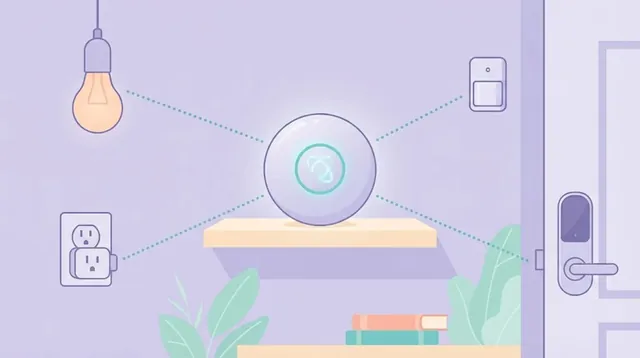
Home Assistant Voice Preview Edition is a small voice assistant built for Home Assistant. It is designed and built by Nabu Casa, the company behind Home Assistant. You say a wake word, give a command and Home Assistant's Assist feature carries it out, such as turning on lights or checking a sensor.
The "Preview" name is honest. Open voice control is still young, and Home Assistant calls AI use in the smart home experimental. Buy it as a privacy-first device that is still improving, not as a drop-in Alexa replacement.
Hardware at a glance
| Part | What Home Assistant lists |
|---|---|
| Price | $69 US recommended price (before tax); €59 in Europe including tax |
| Microphones | Dual-mic array with an XMOS XU316 audio chip for echo cancellation, noise removal and auto gain |
| Speaker | Internal speaker for voice replies; 3.5 mm stereo jack for an external speaker |
| Chip | ESP32-S3 with 16 MB flash and 8 MB PSRAM |
| Connectivity | 2.4 GHz Wi-Fi, Bluetooth 5.0, Grove port for add-ons |
| Controls | Button, rotary dial and a hardware mute switch |
| Power | USB-C, 5 V 2 A (no charger or cable in the box) |
| Size and weight | 84 x 84 x 21 mm, 96 g |
| Software | ESPHome, open-source firmware |
The mute switch is a real privacy feature. Home Assistant says it cuts power to the microphones, rather than just telling software to stop listening. Note that you need to supply your own USB-C power adapter and cable.
Wake words
Out of the box, you can choose "Okay Nabu," "Hey Jarvis" or "Hey Mycroft." Wake word detection runs on the device itself using the microWakeWord engine, so the speaker is not streaming audio until it hears one of those phrases.
Local or cloud: the choice that matters most
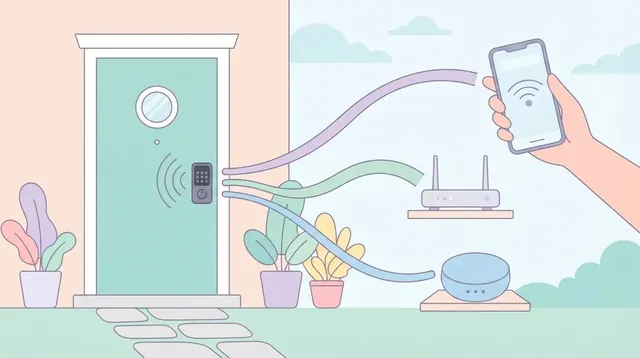
After the wake word, your speech has to be turned into text. Home Assistant gives you three ways to do that.
| Option | Runs where | Understands | Hardware needed |
|---|---|---|---|
| Speech-to-Phrase | Your Home Assistant server | Set home-control phrases only | Low-power hubs are fine |
| Whisper | Your Home Assistant server | General speech | Intel N100 or better recommended for the Base model |
| Home Assistant Cloud | Microsoft Azure via Nabu Casa | General speech | Any Home Assistant system |
Speech-to-Phrase is fast. Home Assistant says it transcribes in under a second, even on a Home Assistant Green or a Raspberry Pi 4. But it only knows a fixed set of commands. Shopping lists, timers and broadcasts don't work with it out of the box.
Whisper tries to understand anything you say. The trade-off is speed. Home Assistant's docs say it takes around 8 seconds per command on a Raspberry Pi 4, but under a second on an Intel NUC. If you run Home Assistant on a Pi, Whisper will feel slow.
Home Assistant Cloud (now branded Home Assistant Link on the Nabu Casa site) handles speech on Microsoft Azure. Home Assistant says Azure does not keep the data. Nabu Casa lists it at $6.50 a month or $65 a year in the US, with a 31-day free trial and no card needed. The subscription also adds remote access, offsite backups and Alexa and Google Home voice control.
Adding an AI model
You can connect a cloud language model from Google, OpenAI or Anthropic, or a local model, as the conversation agent. You can also set it as a fallback, so normal commands stay fast and local while odd questions go to the AI. Remember that cloud AI providers may bill you separately for API use. Our OpenAI API pricing explainer covers how that works.
Languages
The product page lists roughly 70 locales. Local support depends on speech-to-text, sentence support and text-to-speech all being available for your language, and speech-to-text is usually the weak link. Cloud support depends mostly on community translations. Check your language on the product page before buying.
Where to buy
Home Assistant points North American buyers to official distributors: ameriDroid, CloudFree, Seeed Studio and Apollo Automation. Prices vary by retailer, so the $69 figure is a guide.
Should you buy one?
- Yes if you already run Home Assistant and want voice control that never needs Amazon or Google.
- Yes, with the cloud plan if your server is a Pi or Green and you want general speech without new hardware.
- Wait if you mainly want music, broad general knowledge answers or a polished assistant for non-technical family members.
New to the platform? Start with Home Assistant for beginners, then compare ecosystems in Alexa vs Google Home vs Apple Home and SmartThings vs Home Assistant vs Hubitat. Our price table tracks related subscriptions.
FAQ
How much does Home Assistant Voice Preview Edition cost?
The recommended US price is $69 before tax. Retail prices vary by distributor.
Does it need a subscription?
No. It can run locally. Home Assistant Cloud is optional and costs $6.50 a month or $65 a year in the US.
Can it work fully offline?
Yes, if your language is supported locally. Speech-to-Phrase handles set commands on modest hardware, while Whisper handles general speech but needs a faster machine.
What wake words does it support?
"Okay Nabu," "Hey Jarvis" and "Hey Mycroft" out of the box, detected on the device.
Sources
- Home Assistant Voice Preview Edition (checked November 12, 2026)
- Home Assistant: local voice assistant docs (checked November 12, 2026)
- Nabu Casa pricing (checked November 12, 2026)